




- The world is watching the Olympics – and so are your buyers. 21.4M viewers tuned into the Milano Cortina opening ceremony alone, and the conversations it sparks are ones your brand should be part of.
- You don’t need a sponsorship deal to be relevant. The Games surface enterprise themes – performance, resilience, infrastructure – that B2B brands are uniquely positioned to own.
- But only if you plan ahead. Non-sponsor marketing restrictions can be tricky, and strategic decisions for the LA Olympics in 2028 need to happen in Q1–Q2 2026.
The Milano Cortina 2026 opening ceremony broke records – 21.4 million viewers across NBC and the Peacock steaming app, up 34% from Beijing. The games are on pace to be the most-streamed Winter Olympics ever with 700 million minutes of viewing by opening weekend. Billions of people are paying attention, including your customers and executive team.
Why the Olympics are a strategic moment for B2B marketing leaders
Here’s the uncomfortable truth for B2B marketing leaders: if you don’t have an answer ready for “What’s our Olympic strategy?”, there’s a good chance that question is headed to your inbox soon from the C-suite. Or maybe it’s already there.
Your customers, your prospects, and your own executive team are tuned in. It’s only a matter of time before someone up the chain questions the missed opportunity for brand relevance and visibility.
Yet, despite being among the most predictable marketing opportunities on the calendar, the Olympics still catches B2B brands (and many brands in general) flat-footed.
How and when B2B brands should show up to the Olympic conversation
Every two years, the world watches enterprise systems perform under pressure – in real time, at global scale. When they succeed, it’s a proof point. When they fail, it’s a cautionary tale. Either way, it’s a conversation your buyers are listening to.
Take Samsung. As part of The Olympic Partner (TOP) programme, their relationship with the IOC isn’t transactional — it’s in part a services partnership that grants them the rights to activate the Olympics brand before, during, and after the Games. Embedding 26 Galaxy S25 Ultra devices into Milano Cortina’s opening ceremony broadcast wasn’t product placement; it was a Olympic co-branded proof-of-performance moment for the company.
Then consider the CrowdStrike outage that hit Paris 2024 just days before the opening ceremony, forcing manual workarounds for accreditation and uniform delivery. That’s a different B2B story – one about resilience, redundancy and what happens when the contingency plan becomes the plan.
Both events created timely, highly relevant opportunities for B2B brands to flex their expertise. The brands that were ready with their own commentary and content won these moments, not the ones who scrambled to react.
But before you build a strategy, figure out whether you have a genuine angle. Not everyone does. Ask yourself three questions:
- Does your category touch any of the operational systems that make a global event run (e.g., infrastructure, logistics, security, finance, communications)?
- Do you sell to enterprise buyers who are watching the same broadcast your content will reference?
- Do you have a credible point of view on performance, resilience or scale that the Games will surface in the news?
If the answer to at least two of those is yes, you have something to work with. Here’s how to use it:
Four Olympics marketing plays for B2B brands:
- Partner with retired Olympians – not bound by active-athlete restrictions – for thought leadership and executive content
- Publish industry-specific white paper tied to the operational themes the Games
- Use the language of preparation, precision and performance – without touching protected trademarks
- Launch ahead of the Games to establish authority before the noise peaks
Yes, the rules are strict. You cannot use trademarks, team names or official logos associated with the Olympics. You cannot imply official association. Active athletes cannot promote non-sponsor brands during competition periods. But the conversation isn’t restricted.
If you’re in logistics, publish something on the complexity of supply chains for global events. If you’re in cybersecurity, break down how mega-events defend against nation-state threats. If you provide infrastructure technology, explain what it takes to support hundreds of millions of streaming minutes without failure. You don’t need a logo on the podium – you need a point of view when enterprise performance is suddenly front-page news.
The smartest brands don’t chase visibility. They prepare to speak when the conversation turns to exactly what they know how to solve.
The planning window is shorter than you think
The Olympics happen every two years on announced dates. There’s no excuse for being caught off guard. Yet here we are.
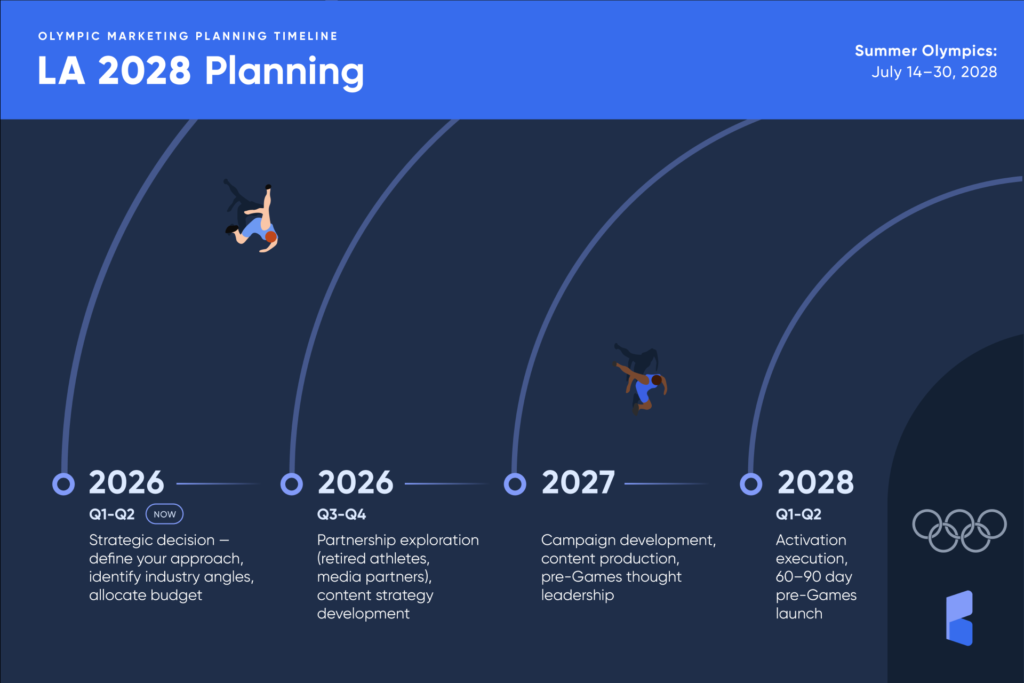
Olympics marketing that moves the needle starts 12–18 months before the Games, not during them. That means the LA 2028 Summer Olympics, happening July 14–30, need strategic marketing decisions to be made right now, in Q1–Q2 2026.
Miss this window and you’re not just late – you’re irrelevant.
Why B2B brands should include the Paralympics in their Olympic marketing strategy
The conversation doesn’t end when the Olympics flame goes out. The Milano Cortina 2026 Winter Paralympic Games run March 6–15, 2026, bringing roughly 600 athletes from around the world across six sports. The global audience continues – and it’s a significantly less crowded media moment.
For B2B brands, the Paralympics are a distinct opportunity: an engaged, growing audience, reduced competitive noise, and significant cultural gravity. The planning principles are identical. Show up with substance, early.
Cultural fluency beats big budgets
The best Olympics marketing has never come from the biggest budgets. It comes from brands with a genuine point of view, long-range planning, and the creative agility to act when the moment arrives.
While your competitors may dismiss this as too restrictive or too complex, you can be planning now for LA 2028, Brisbane 2032, and every cultural moment in between. You don’t need to capitalize on everything – just the right things, at the right time, with a message that’s truly yours.
The Olympics aren’t going anywhere. Neither is the C-suite email asking what you have planned.
So… will you have a strategy the next time the torch is lit?