



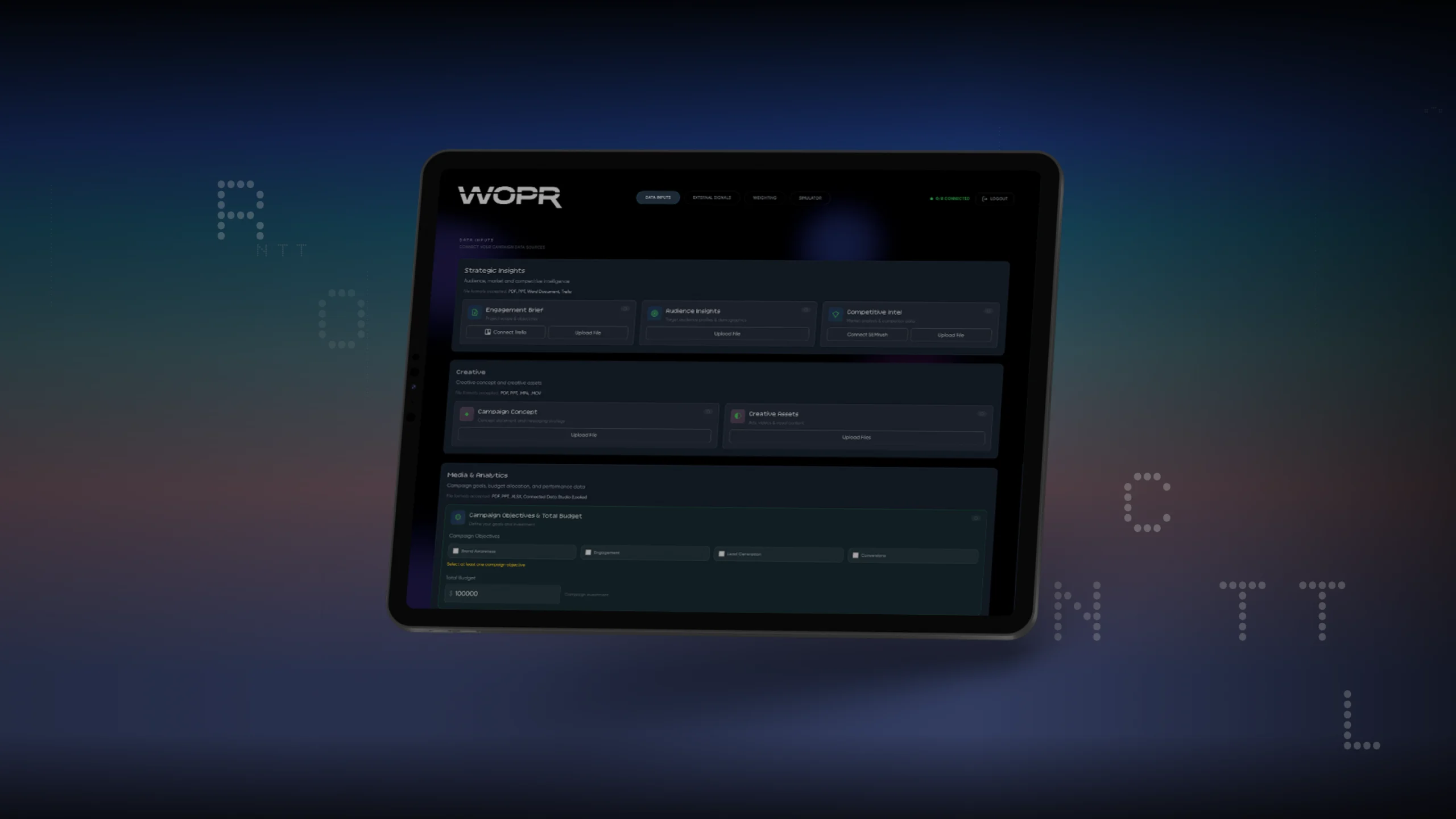
- Intelligent planning systems are helping marketers adapt faster and optimize budgets more effectively.
- The W.O.P.R. (What-if Outcome Prediction & Response engine) from Park & Battery helps marketing teams reduce planning inefficiencies through contextual adjustment, automated scenario modeling and AI-driven recommendations.
- Teams have already saved 682 combined planning hours and achieved an average 62.1% lower CPA through scenario-based planning.
Marketing teams are under growing pressure to make faster, smarter campaign decisions in increasingly complex environments. In this blog, we’ll explore how Park & Battery’s W.O.P.R. (What-if Outcome Prediction & Response) decisioning engine is changing the way marketing teams model scenarios, optimize investments and adapt to change.
Modern campaigns demand smarter planning
Campaign planning used to be relatively straightforward: build the strategy, align the channels, allocate the budget, launch the campaign.
But today, the reality looks very different.
Marketing teams are managing increasingly fragmented audiences with tighter timelines, shifting performance expectations, and a whole new breadth of channel ecosystems. And that strain shows up most clearly in time and efficiency.
That’s why Park & Battery built the What-If Prediction and Response (W.O.P.R.) engine. With it, teams have already saved a combined 682 hours of planning, while also achieving an average of 62.1% lower cost-per-action through more informed, scenario-driven decisions.
Because the W.O.P.R. was designed to bring greater clarity to the decisions that shape campaign performance. To help teams model scenarios and understand potential impact before investment is ever allocated.
Below, we will explore what that looks like in practice, covering what makes the W.O.P.R. your best tool for campaign planning excellence.
Planning that adapts in real time
When a pivot becomes necessary, teams spend valuable time rebuilding, reallocating, reconsolidating, often with limited visibility into how one change may affect the broader campaign ecosystem.
And while information is more abundant than ever, that in itself is an obstacle. Marketers are drowning in it, unable to operationalize quickly and intelligently enough to keep pace.
That’s where the W.O.P.R. changes the equation.
Built to modernize campaign planning, the W.O.P.R. combines:
- Industry benchmark intelligence
- Channel-specific optimization logic
- Real-time market signal integration
- Objective alignment scoring
- Budget pacing analysis
Together, these capabilities help teams move beyond reactive planning and toward a more connected, adaptive decision-making process. Because while many planning tools rely on limited inputs or static optimization models, the W.O.P.R. is designed to account for a broader and more nuanced range of campaign variables – including factors that other systems often overlook entirely.
But adapting to change is only part of the challenge. Teams also need the ability to quickly explore multiple paths forward.
Evaluating more campaign paths in less time
Another common barrier to smarter campaign planning is the sheer amount of time it takes to explore alternatives. As a result, planning often defaults to the safest or most familiar option rather than the most optimized one.
The W.O.P.R. changes that process through automated scenario generation and optimization – having run 65,463,657 scenarios to date.
This involves the use of efficiency-based channel ranking, and four algorithmic scenarios to choose from:
- Current plan baseline
- Shift 20% to highest performer
- Reduce underperformers by 30%
- Add high-ROAS channels (Email/Search)
These algorithms model budget reallocation scenarios and project expected performance outcomes. This allows teams to quickly generate, compare and refine campaign approaches against defined objectives and constraints, moving from static models to more agile, data-informed models.
Teams will have a structured way to stress-test decisions in real time, making it easier to identify optimal allocations and understand tradeoffs that help them move with greater speed and confidence.
Even the best planning models still depend on creative decisions though, and that’s where many teams hit another bottleneck.
Turn data into creative recommendations
Creative optimization still relies heavily on experience and expertise, and in practice, most teams don’t have the resources for truly comprehensive testing across every variable that matters. The W.O.P.R. helps close that gap through an AI-driven creative recommendation engine designed to surface actionable planning guidance in real time.
Rather than requiring teams to sift through endless variables and reports, The W.O.P.R.’s multi-layered recommendation engine generates specific creative, messaging and format suggestions based on objectives, market conditions and channel mix.
There are five processing layers at work:
- Objective-based creative selection
- Industry-specific customization
- Market signal integration
- Channel-specific optimization
- Data-driven personalization
Together, these create adaptive messaging based on market trend direction, along with format recommendations for each channel type and priority scoring for recommendations.
This allows teams to:
- Prioritize high-impact planning decisions faster
- Reduce analysis paralysis during campaign development
- Improve consistency across campaign strategies
- Surface optimization opportunities that may otherwise be overlooked
- Increase confidence in media, budget and channel allocation decisions
The result is a stronger creative output with a measurable reduction in the time and effort required to get there.
The future of campaign planning is now more intelligent
As campaign complexity continues to grow, marketing organizations need planning systems that can adapt in real time, respond proactively and keep pace with rising expectations.
The W.O.P.R. represents that shift with its intelligent approach to campaign planning, one that brings together contextual adaptability, scenario optimization and recommendation-driven guidance. With it, users can bring greater clarity to the decisions that shape campaign performance – well before the first layer is even stacked on the campaign-shaped bun.
If you’re interested in learning more, contact us and schedule a demo to see how the W.O.P.R. helps teams plan with greater clarity, confidence and efficiency before campaigns ever launch.